
Signs You May Need Trauma Therapy in Chicago (And How to Start Healing)
Key Takeaways
- Trauma isn’t limited to major disasters — chronic stress, loss, betrayal, and childhood experiences count too.
- Common signs include hypervigilance, avoidance, sleep problems, and emotional numbness.
- EMDR, trauma-focused CBT, and somatic therapy are among the most researched, effective treatments available.
- Many clients notice meaningful change within 6–12 EMDR sessions for single-incident trauma; complex trauma often takes longer.
- Chicago’s pace, commute stress, and seasonal weather shifts can intensify trauma symptoms.
- Both in-person and virtual trauma therapy are available for Chicago and Illinois residents.
Table of Contents
- What Trauma Really Means (and Why It’s Often Overlooked)
- 9 Signs You May Need Trauma Therapy in Chicago
- Trauma, PTSD, Anxiety, and Depression: How to Tell the Difference
- Evidence-Based Trauma Therapies That Work
- Why Chicago Life Can Make Trauma Symptoms Harder to Manage
- What Happens in Your First Trauma Therapy Session
- In-Person or Virtual Trauma Therapy in Chicago?
- How Austin Trauma Therapy Center Supports Chicago Clients
- When to Reach Out
- FAQs
If small things have started triggering big reactions lately — a slammed door, a tense email, a crowded Red Line platform — you’re not imagining it. Trauma rarely looks like the dramatic scenes we see in movies. More often, it shows up as a tight chest before a meeting. A short fuse with people you love. An unexplained urge to avoid a certain street. In session, I hear versions of this almost every week from clients who assumed their reaction was “overkill” for whatever they’d been through. It usually isn’t. If you’ve been quietly wondering whether what you’re feeling is “serious enough” to need help, this guide is for you. Below, you’ll find the signs that often point to unresolved trauma, the evidence-based therapies that help people recover, and what trauma therapy in Chicago actually looks like — so you can take your next step with clarity instead of guesswork.
What Trauma Really Means (and Why It’s Often Overlooked)
Many people think trauma only follows something catastrophic — a serious accident, an assault, combat, or a natural disaster. Mental health professionals sometimes call these “big T” traumas, and they absolutely deserve support. But trauma also includes what’s sometimes called “little t” trauma: ongoing stress that wears down your sense of safety over time. Examples include a difficult childhood, a toxic workplace, an unstable relationship, medical trauma, or repeated experiences of discrimination.
The Substance Abuse and Mental Health Services Administration (SAMHSA) describes trauma as an event, or series of events, that a person experiences as physically or emotionally harmful, with lasting effects on functioning and wellbeing. That definition matters because it means you don’t need a single dramatic incident to justify seeking help. If an experience has changed how safe, in control, or connected you feel, it’s worth taking seriously.
This is one reason trauma often goes unaddressed for years. People minimize what happened to them (“others had it worse”) or don’t connect their current struggles — anxiety, irritability, exhaustion — back to an earlier experience. A licensed trauma therapist can help you see that connection clearly, without judgment.
9 Signs You May Need Trauma Therapy in Chicago
- Flashbacks or intrusive memories — vivid, unwanted memories that resurface during ordinary moments, sometimes triggered by a smell, sound, or place.
- Hypervigilance — feeling constantly “on alert,” scanning rooms or streets for danger even when you’re objectively safe.
- Avoidance — steering clear of certain neighborhoods, conversations, people, or even the CTA route tied to a difficult memory.
- Emotional numbness — feeling disconnected from your own emotions, or from people you care about.
- Sleep disruption — nightmares, trouble falling asleep, or waking up with a racing heart for no clear reason.
- Trust and relationship strain — difficulty getting close to others, or swinging between over-attachment and pulling away.
- Unexplained physical symptoms — headaches, stomach issues, muscle tension, or fatigue that doctors can’t fully explain.
- Persistent guilt or shame — blaming yourself for something that happened to you, even when logically you know it wasn’t your fault.
- Using busyness or substances to cope — overworking, overscheduling, or drinking to avoid sitting with difficult feelings.
If several of these sound familiar, it doesn’t mean something is wrong with you — it means your nervous system is still trying to protect you from something that already happened. Trauma therapy helps your brain and body update that information.

Figure 1 — 9 Signs You May Need Trauma Therapy in Chicago
Trauma, PTSD, Anxiety, and Depression: How to Tell the Difference
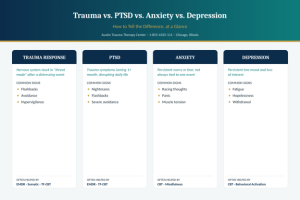
These conditions often overlap, and a side-by-side comparison can help you see where your experience fits.
| Condition | Core Feature | Common Signs | Often Helped By |
| Trauma response | Nervous system stuck in “threat mode” after a distressing event | Flashbacks, avoidance, hypervigilance | EMDR, somatic therapy, trauma-focused CBT |
| PTSD | Trauma symptoms lasting over a month and disrupting daily life | Nightmares, flashbacks, severe avoidance | EMDR, trauma-focused CBT |
| Anxiety | Persistent worry or fear, not always tied to a specific past event | Racing thoughts, panic, muscle tension | CBT, mindfulness-based therapy |
| Depression | Persistent low mood and loss of interest | Fatigue, hopelessness, withdrawal | CBT, behavioral activation |
Someone with unresolved trauma may also meet criteria for PTSD, anxiety, or depression at the same time. That’s normal — and it’s exactly why a thorough assessment matters more than a single label. A trauma-informed therapist looks at the full picture rather than treating symptoms in isolation.
Evidence-Based Trauma Therapies That Work
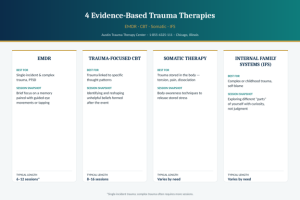
| Therapy | Best For | What a Session Involves | Typical Length |
| EMDR | Single-incident and complex trauma, PTSD | Brief focus on a memory paired with guided eye movements or tapping | 6–12 sessions (single-incident); longer for complex trauma |
| Trauma-Focused CBT | Trauma linked to specific thought patterns | Identifying and reshaping unhelpful beliefs formed after the event | 8–16 sessions |
| Somatic Therapy | Trauma stored in the body (tension, pain, dissociation) | Body-awareness techniques to release stored stress | Varies; often paired with EMDR or CBT |
| Internal Family Systems (IFS) | Complex or childhood trauma, self-blame | Exploring different “parts” of yourself with curiosity instead of judgment | Varies by individual need |
EMDR is one of the most researched treatments for PTSD; the U.S. Department of Veterans Affairs lists it among the top recommended therapies for combat-related PTSD. Unlike traditional talk therapy, EMDR doesn’t require you to describe every detail of what happened. Many clients say this makes it feel more manageable, especially for memories that are hard to put into words. Your therapist will always assess whether EMDR — or another approach — fits your specific history and goals before beginning treatment.
Why Chicago Life Can Make Trauma Symptoms Harder to Manage
Trauma recovery doesn’t happen in a vacuum — your environment matters. Chicago’s fast pace, long commutes on the Blue, Red, or Brown lines, and demanding industries like finance, healthcare, and education can leave little room to process difficult experiences. Add in Midwest winters, when shorter days and less sunlight can worsen mood and energy, and it’s easy to see why trauma symptoms often intensify here rather than fade on their own.
City life can also create a paradox: you’re surrounded by millions of people, yet trauma often makes people feel more isolated than ever. Whether you live in Lincoln Park, Pilsen, Hyde Park, or the suburbs beyond the city limits, the pressure to keep up appearances — showing up to work, staying social, “pushing through” — can bury symptoms rather than resolve them.
A therapist who understands these local pressures can help you build coping strategies that fit your actual life, not a generic routine. In practice, that often looks like something simple: a 7:30am virtual session before the Loop commute starts, or a Saturday slot for someone whose job doesn’t allow weekday flexibility. Small logistics like that determine whether therapy is sustainable or one more thing that falls off the calendar by week three.
What Happens in Your First Trauma Therapy Session
Starting therapy can feel intimidating, especially if you’ve never talked about what happened. Your first session typically focuses on your history, current symptoms, and goals — not a deep dive into the traumatic event itself. Your therapist will ask questions to understand what you’ve experienced and how it’s affecting your daily life, then explain which treatment approach might help.
You won’t be asked to relive the trauma in detail right away. Trauma-informed care is built around trust and pacing; your therapist will move at a speed that feels safe for you, building coping tools before any deeper processing work begins. It’s also completely normal to feel nervous, unsure what to share, or emotional during this first conversation — some clients cry, some go quiet, some talk fast to get through it. All of that is fine. A good trauma therapist will meet you exactly where you are, without pressure or judgment.
In-Person or Virtual Trauma Therapy in Chicago — Which Is Right for You?
Both options are effective, and the right choice depends on your comfort and schedule. In-person therapy can feel more grounding for people who benefit from a dedicated, distraction-free space, or for approaches like somatic therapy that involve body awareness.
Virtual trauma therapy offers flexibility for busy professionals, parents, or anyone who wants to start sooner without adding a commute. EMDR, CBT, and talk therapy all translate well to secure video sessions, and research shows telehealth EMDR can be just as effective as in-person sessions for many clients.
Illinois residents can typically access either format, often with the same therapist, so you can adjust as your needs change — starting virtual during a busy season, for example, and shifting to in-person later.
How Austin Trauma Therapy Center Supports Chicago Clients
Austin Trauma Therapy Center (ATTC) provides trauma-informed care to clients throughout Illinois, including Chicago, through licensed therapists trained in EMDR, trauma-focused CBT, somatic therapy, and Internal Family Systems. Every clinician on our team completes ongoing training in trauma-informed practices, and treatment plans are built around your specific history rather than a one-size-fits-all program.
We know that reaching out is often the hardest step. That’s why our approach centers on flexibility: secure virtual sessions for Illinois residents, evening and weekend scheduling options, and a judgment-free intake process designed to help you feel supported from the first conversation. Whether you’re managing PTSD, anxiety, depression, or the lingering effects of childhood trauma, our team works collaboratively with you to set a pace and plan that fits your life.
Recovery looks different for everyone, and there’s no “right” timeline for healing. What matters most is working with a team that listens, explains your options clearly, and adapts care as you grow.
When to Reach Out
You don’t need to hit a breaking point before seeking support. If any of the signs above have been present for a few weeks or more, or if they’re affecting your work, relationships, or daily functioning, it’s a reasonable time to talk with a professional.
If you’re in Chicago or anywhere in Illinois and recognize yourself in this article, reaching out for an initial conversation costs nothing but a little vulnerability — and it could be the first step toward feeling steadier, calmer, and more like yourself again. Contact Austin Trauma Therapy Center to schedule a session, or explore our trauma therapy services in Chicago, IL to learn more about what treatment could look like for you.
FAQs
1. How do I know if I need trauma therapy versus regular counseling?
General counseling can help with everyday stress, but trauma therapy uses specialized approaches like EMDR to address the way traumatic memories are stored in the brain and body. If standard talk therapy hasn’t relieved symptoms like flashbacks or hypervigilance, trauma-focused treatment may be the missing piece.
2. Can trauma symptoms show up years after the event?
Yes. It’s common for trauma symptoms to surface months or even years later, often triggered by a new stressor, life transition, or reminder of the original event.
3. What’s the difference between PTSD and complex PTSD (C-PTSD)?
PTSD typically follows a single traumatic event, while complex PTSD develops after repeated or prolonged trauma, such as ongoing childhood neglect or long-term abuse. Complex PTSD often includes additional challenges with self-worth and relationships.
4. Is EMDR painful, or will I have to relive my trauma in detail?
EMDR does not require you to describe every detail of what happened. You’ll briefly focus on a memory while your therapist guides bilateral stimulation, and most clients find the process far less distressing than traditional exposure-based approaches.
5. How soon will I feel better after starting trauma therapy?
Many clients notice initial relief within a few sessions, though meaningful progress for single-incident trauma often takes 6–12 EMDR sessions. Complex or long-standing trauma typically requires more time.
6. Can I benefit from trauma therapy without one specific traumatic event?
Yes. Ongoing stress, neglect, or a difficult upbringing can create trauma responses even without one identifiable incident. Trauma therapy still applies and can be highly effective.
7. What if I’m not ready to talk about what happened?
That’s completely normal, and you’re never required to share more than feels safe. Trauma-informed therapists build trust and coping skills first, at your pace.
8. Does insurance cover trauma therapy in Chicago?
Many providers accept insurance or offer flexible payment options for trauma therapy. It’s worth asking your provider directly about your specific plan and any sliding-scale options.
9. Can trauma therapy help with the stress and burnout of city life?
Yes. Trauma therapy addresses the nervous system’s stress response, which often overlaps with burnout symptoms like exhaustion, irritability, and difficulty relaxing — common experiences for Chicago’s fast-paced professionals.
10. How do I choose the right trauma therapist in Chicago?
Look for a licensed clinician with specific training in trauma treatment (such as EMDR certification), and consider scheduling a consultation to see if their approach feels like a good fit for you.
Conclusion
Recognizing the signs of unresolved trauma is often the hardest part — after that, healing becomes a series of manageable steps rather than one overwhelming leap. Whether your experience involved a single event or years of accumulated stress, evidence-based trauma therapy in Chicago can help you feel calmer, safer, and more in control of your life again. If you’re ready to talk with a licensed, trauma-informed therapist, reach out to Austin Trauma Therapy Center today to schedule your first session.