Some of the heaviest weight we carry doesn’t come from a single dramatic event; it comes from years of unresolved stress quietly reshaping how safe we feel in our own lives. If you’ve been searching for support and aren’t sure where to start, you’re already doing the hardest part.
Chicago is home to a wide range of mental health providers, which can make the search feel overwhelming rather than reassuring. This guide breaks down what to look for, plus five options worth knowing about, so finding trauma therapy in Chicago, IL feels less like guesswork and more like a clear next step.
What Should You Look for in a Trauma Counselor in Chicago?
Not every therapist practices trauma-informed care the same way, so it helps to know what separates a good fit from a frustrating one. A few minutes spent reviewing these factors upfront can save weeks of trial and error later.
Specialized training: Look for certifications in EMDR, trauma-focused CBT, or somatic therapy rather than general talk therapy alone.
Experience with overlapping conditions: A strong trauma counselor also understands anxiety therapy in Chicago, IL residents seek, along with depression treatment in Chicago, IL and PTSD therapy in Chicago, IL, since these conditions frequently occur together.
Flexible scheduling: Evening, weekend, or virtual sessions matter for people juggling demanding jobs or long commutes.
A judgment-free intake process: The first conversation should feel collaborative, not clinical or rushed.
Clear communication about treatment plans: You should always understand why a particular approach is being recommended for you.
The organization provides trauma-informed care to clients throughout Illinois, including Chicago, through licensed clinicians trained in EMDR, trauma-focused CBT, somatic therapy and Internal Family Systems.
Its services also address concerns such as anxiety and depression, including depression treatment in Chicago IL, through individualized therapeutic approaches.
The organization’s model emphasizes flexibility, with secure virtual sessions, evening and weekend availability, and treatment plans developed around each client’s individual history and clinical needs rather than a standardized program.
Whether someone is managing PTSD, anxiety, depression, or the lasting effects of childhood trauma, we work collaboratively to set a pace that actually fits their life, not the other way around.
Lincoln Park Trauma & Wellness Collective
A group practice known for combining talk therapy with mindfulness-based techniques, serving adults working through relationship strain and chronic stress..
Ravenswood Community Counseling
Offers sliding-scale sessions and a strong focus on culturally responsive care for clients navigating grief, loss, and identity-related trauma..
Hyde Park Behavioral Health Group
A multidisciplinary team providing both individual and group therapy formats, with an emphasis on trauma linked to medical or workplace stress.
Loop Mind & Body Therapy
A downtown practice geared toward busy professionals, offering short-term, goal-focused sessions alongside longer-term trauma processing work.
Why Choose Austin Trauma Therapy Center for Trauma Therapy in Chicago, IL?
Choosing a counselor is a personal decision, particularly for people seeking specialized support such as anxiety therapy in Chicago IL.
For Chicago clients, the organization’s approach emphasizes individualized treatment planning, virtual access and care tailored to each person’s history and stated needs rather than a standardized program:
Specialized modalities: EMDR, trauma-focused CBT, somatic therapy, and IFS, matched to each client’s history.
Illinois-wide virtual access: No need to be near a physical office to start.
Judgment-free intake: Designed to help people feel supported from the very first conversation.
Integrated care: We treat trauma alongside co-occurring anxiety, depression, and PTSD symptoms rather than in isolation.
Flexible scheduling: Evening and weekend slots built for people with demanding routines.
How is trauma therapy different from general counseling?
Trauma therapy uses specialized methods, like EMDR, that target how traumatic memories are stored in the brain, rather than only discussing current stressors.
Can trauma cause anxiety and depression?
Yes. Unresolved trauma frequently overlaps with anxiety and depression, which is why an integrated treatment plan often works better than treating each symptom separately.
Is virtual trauma therapy as effective as in-person sessions?
Research suggests telehealth EMDR and CBT can be comparably effective for many clients, making virtual trauma therapy in Chicago, IL a practical option for busy schedules.
How long does trauma therapy typically take?
Single-incident trauma often shows improvement within 6 to 12 sessions, while complex or long-standing trauma usually requires a longer, individualized timeline.
Does insurance cover trauma counseling in Chicago?
Many providers accept insurance or offer flexible payment arrangements, so it’s worth confirming coverage details directly with your chosen counselor.
How do I choose between the counselors on this list?
Start by matching your needs to each provider’s focus, whether that’s specialized modalities, scheduling flexibility, group settings, or location, then schedule a brief consultation before committing to ongoing sessions.
Choosing the right support shouldn’t add more stress to an already difficult season. Whether you’re weighing your options or ready to book a first session, quality trauma therapy in Chicago, IL is more accessible than it may seem, and taking the time to compare a few providers now can make a real difference in how quickly you start feeling supported.
If you’re ready to talk with a licensed, trauma-informed team, reach out to Austin Trauma Therapy Center to schedule your first appointment today.
A racing heart during a routine meeting. A sudden urge to avoid a familiar street. These reactions aren’t overreactions; they’re signals from a nervous system still trying to protect you.
If you’ve wondered whether professional support could help, trauma therapy in Chicago, IL combines proven approaches like EMDR, CBT, and somatic work to help you process the past and function with more ease day to day.
What Is Trauma Therapy, and Who Is It For?
Trauma therapy is a specialized form of treatment designed to help the nervous system process distressing events instead of staying stuck in a state of alert. It’s for anyone whose past experiences, whether a single incident or years of chronic stress, are still affecting their emotions, relationships, or physical health today.
You don’t need a dramatic backstory to benefit; ongoing stress, a difficult childhood, or ongoing conflict can all leave a lasting imprint that trauma therapy is built to address.
What Approaches Does Trauma Therapy in Chicago Use?
Effective trauma treatment rarely relies on one single method. Instead, therapists draw from several evidence-based approaches depending on your history and how your symptoms show up.
EMDR (Eye Movement Desensitization and Reprocessing): Pairs brief focus on a distressing memory with guided eye movements, helping the brain reprocess it without requiring you to describe every detail.
Trauma-Focused CBT: Identifies unhelpful thought patterns formed after a traumatic event and replaces them with healthier ones.
Somatic Therapy: Addresses trauma stored physically, such as chronic tension, fatigue, or dissociation.
Anger Management Therapy in Chicago, IL: Helps clients whose trauma response shows up as irritability, outbursts, or a short fuse, teaching healthier ways to recognize and regulate that response.
How Does a Trauma Assessment Work?
A trauma assessment for adults in Chicago is usually the starting point for treatment, and it’s far less clinical than it sounds. During this initial conversation, a therapist asks about your history, current symptoms, and goals to understand how past experiences are affecting your present life.
This isn’t about reliving every detail of what happened; it’s about building an accurate picture so your treatment plan actually fits your needs rather than following a generic script. Clients often tell us this first conversation feels like relief rather than pressure, simply because someone is finally asking the right questions.
What Are the Real Benefits of Trauma Therapy?
The goal of trauma therapy isn’t just symptom relief; it’s restoring a sense of safety and control. Clients frequently report better sleep, steadier relationships, and fewer physical symptoms like headaches or muscle tension once the nervous system stops operating in constant threat mode.
Research consistently shows that EMDR is among the most effective treatments for PTSD, and many clients notice meaningful change within 6 to 12 sessions for single-incident trauma, with complex trauma typically requiring more time.
Do I Need a PTSD Therapist or a General Trauma Therapist?
Not everyone with trauma symptoms meets the criteria for PTSD, and that distinction matters when choosing care. A PTSD therapist in Chicago specializes in symptoms that have persisted for a month or longer and significantly disrupt daily functioning, such as nightmares, flashbacks, and severe avoidance.
If your symptoms are more recent, milder, or tied to ongoing stress rather than a specific event, a general trauma therapist trained in the same core methods can still provide effective, targeted support.
How Do I Get Started with Trauma Therapy in Chicago?
Getting started is simpler than most people expect. It typically begins with a brief conversation to discuss your concerns, followed by a full assessment and a personalized treatment plan.
From there, sessions are scheduled at a pace that fits your comfort level, whether that means weekly EMDR sessions or a slower, more gradual approach.
How We Support Clients in Chicago?
We work with Illinois residents through licensed therapists trained in EMDR, trauma-focused CBT, somatic therapy, and anger management support. Every treatment plan we build is centered on your specific history, with flexible virtual scheduling designed around Chicago’s demanding pace of life.
FAQs
How long does trauma therapy usually take?
Many clients see meaningful progress within 6 to 12 sessions for single-incident trauma, while complex or long-standing trauma often takes longer.
Is a trauma assessment required before starting therapy?
Yes, most therapists begin with an assessment to understand your history and symptoms so treatment can be tailored to your specific needs.
Can trauma therapy help with anger issues?
Yes. Anger is a common trauma response, and anger management therapy is often incorporated into trauma treatment to address underlying triggers.
What’s the difference between trauma therapy and PTSD therapy?
PTSD therapy specifically targets symptoms lasting over a month that disrupt daily life, while trauma therapy can address a broader range of distressing experiences.
Does insurance cover trauma therapy in Chicago?
Many providers accept insurance or offer flexible payment options, so it’s worth confirming details directly with your chosen therapist.
Contact Us Now!!
Healing from trauma starts with understanding how it affects your mind and body, then choosing the right combination of care. Whether you need a full trauma assessment, PTSD-focused treatment, or support with anger and stress, trauma therapy in Chicago, IL offers a path forward.
A single headache turns into hours of searching symptoms online. A normal heartbeat suddenly feels like something is wrong. If this cycle sounds familiar, you’re not imagining things, and you’re not alone in this struggle.
Health anxiety can quietly take over daily life, but the right support from a qualified therapist in Chicago can help you separate genuine health concerns from anxiety-driven fear.
What Is Health Anxiety?
Health anxiety, sometimes called illness anxiety, is a persistent fear of having or developing a serious medical condition, even when tests and doctors repeatedly confirm there’s nothing wrong. It’s different from occasionally worrying after a concerning symptom; it becomes a pattern that consumes time, energy, and peace of mind.
People with health anxiety often cycle through relief after reassurance, followed by new worry within days or even hours.
What Causes Health Anxiety to Develop?
Health anxiety rarely appears out of nowhere. It often develops after a personal health scare, watching a loved one go through a serious illness, or growing up in a household where health was a constant source of stress.
For some people, it’s connected to a broader anxiety disorder, while for others, it traces back to unresolved fear or trauma around illness, mortality, or loss of control. Understanding the root cause is often the first step toward treating the symptom itself.
How Do I Know if My Worry Has Become a Problem?
Occasional health concerns are a normal part of life, but health anxiety crosses a line when it starts interfering with your daily functioning. Recognizing the difference matters because it determines whether self-management is enough or whether professional support is needed.
Repeatedly checking your body for symptoms multiple times a day.
Frequent doctor visits or emergency room trips despite normal test results.
Spending significant time researching symptoms or diagnoses online.
Avoiding medical appointments entirely out of fear of bad news.
Seeking constant reassurance from family, friends, or search engines.
Difficulty concentrating at work or enjoying activities due to health worries.
If several of these patterns feel familiar, it’s a strong sign that health anxiety, rather than an actual medical issue, may be driving your distress.
Can Health Anxiety Be Connected to Past Trauma?
Yes, and this connection is often overlooked. For some people, health anxiety stems directly from a frightening medical experience, a traumatic diagnosis, or witnessing a loved one suffer through illness without warning.
When the body has learned that health can change instantly and without control, hypervigilance around physical symptoms becomes a protective response rather than an irrational one.
In these cases, Chicago trauma abuse counseling can address the underlying fear response instead of only managing surface-level worry, often producing more lasting relief than reassurance alone.
What Treatment Options Help With Health Anxiety?
Effective treatment for health anxiety typically targets both the anxious thought patterns and the underlying fear driving them.
Cognitive Behavioral Therapy (CBT): Helps identify and challenge distorted beliefs about symptoms and illness.
Exposure-based techniques: Gradually reduce the need for reassurance-seeking behaviors like repeated checking or googling symptoms.
Trauma-focused therapy: Addresses past medical trauma or loss that may be fueling the anxiety.
Mindfulness-based strategies: Build tolerance for uncertainty, which is often at the core of health anxiety.
Could Group Therapy Help With Health Anxiety?
For many people, health anxiety feels isolating, especially when friends or family grow frustrated with repeated reassurance-seeking. Group Therapyin Chicago, IL offers a space to connect with others who understand this specific struggle without judgment.
Hearing that someone else has spent hours worrying over a minor symptom, or avoided a doctor’s appointment out of fear, can be enormously validating. Group settings also provide practical tools for managing anxious thoughts, modeled by peers who are further along in their recovery.
Is There a Link Between Health Anxiety and ADHD?
Health anxiety and ADHD can overlap more than people expect, particularly around difficulty regulating intrusive thoughts and impulsive reassurance-seeking behaviors like repeated symptom searches.
For adults managing both, ADHD Coaching in Chicago, IL can complement anxiety treatment by building structured routines that reduce the mental space available for spiraling health worries. Coaching focuses on practical strategies, like scheduling designated “worry time” instead of allowing health concerns to intrude throughout the day.
What Happens in a First Session for Health Anxiety?
A first session typically starts with understanding your specific worry patterns, including how often they occur, what triggers them, and how they’ve affected your daily life. Your therapist will also ask about any past health scares or losses that may be connected to your current anxiety.
From there, treatment usually begins with practical coping strategies before moving into deeper work on the underlying fear, ensuring you build tools for relief early rather than waiting for the entire process to unfold.
How We Support Clients With Health Anxiety?
We help clients throughout Chicago work through health anxiety using CBT, exposure-based strategies, and trauma-informed care when past experiences are part of the picture. Our team also offers group therapy and ADHD coaching for clients who benefit from additional structure and peer support alongside individual treatment.
FAQs
Is health anxiety considered a real diagnosis?
Yes, it’s recognized clinically as illness anxiety disorder, distinct from general anxiety, and it responds well to targeted treatment approaches like CBT.
Why do I feel temporary relief after a doctor visit but worry again soon after?
This pattern is common with health anxiety, since reassurance provides short-term comfort but doesn’t address the underlying fear driving the worry cycle.
Can health anxiety cause physical symptoms of its own?
Yes. Anxiety itself can produce real physical sensations like a racing heart, dizziness, or stomach discomfort, which can then reinforce health-related fears.
Is it possible to have health anxiety without ever having a serious illness?
Absolutely. Many people develop health anxiety after witnessing someone else’s illness or experiencing a frightening medical scare that turned out to be minor.
How is health anxiety different from generalized anxiety disorder?
Health anxiety centers specifically on fears about illness or bodily symptoms, while generalized anxiety involves broader worry across multiple areas of life.
Get in Touch With Us!!
Health anxiety can make even normal physical sensations feel like emergencies, but understanding the pattern is the first step toward breaking it. With the right combination of therapy, group support, or coaching, working with a skilled therapist in Chicago can help you trust your body again.
Wondering where to start? Connect with Austin Trauma Therapy Center for a conversation tailored to your specific worries.
You did everything right. You took the medication, showed up to sessions, tried to stay hopeful, and still feel stuck in the same heaviness. That experience is more common than most people realize, and it doesn’t mean therapy has failed you.
When standard treatment isn’t working, the answer usually isn’t giving up; it’s shifting toward a more comprehensive, trauma-informed approach to depression treatment in Chicago, IL that looks beyond symptoms alone.
What Is Treatment-Resistant Depression?
Treatment-resistant depression refers to depression that hasn’t significantly improved after trying at least two different antidepressant medications or standard treatment approaches at adequate doses and duration.
It doesn’t mean nothing will work for you; it means the first attempts haven’t addressed the root of what’s driving your symptoms. This distinction matters because it shifts the conversation from “why isn’t anything helping me” to “what haven’t we tried yet.”
Why Doesn’t Standard Treatment Always Work?
Depression isn’t always a straightforward chemical imbalance that responds predictably to medication. For many people, symptoms are tangled up with unresolved trauma, chronic stress, undiagnosed ADHD, or co-occurring anxiety, none of which a standard antidepressant alone is designed to address.
If treatment only targets mood symptoms without exploring what’s underneath them, progress often stalls, even with a technically “correct” prescription and consistent therapy attendance.
How Are Trauma and Depression Connected?
Unresolved trauma can quietly fuel depression symptoms that don’t respond to conventional treatment. A difficult childhood, a significant loss, or ongoing stress can keep the nervous system stuck in a state of exhaustion and hopelessness that mirrors clinical depression but has a different root cause.
In these cases, trauma-focused approaches like EMDR or trauma-focused CBT often succeed where general talk therapy hasn’t, because they address the underlying experience rather than only the surface-level mood symptoms.
Could Undiagnosed ADHD Be Part of the Picture?
For some adults, what looks like treatment-resistant depression is actually undiagnosed or unmanaged ADHD contributing to chronic feelings of failure, overwhelm, and low motivation. Years of struggling to meet expectations without understanding why can create a layer of depression on top of an underlying attention or executive-functioning challenge.
This is one reason Adult ADHD coaching services in Chicago, IL are increasingly paired with traditional depression treatment, since coaching addresses daily functioning in a way medication and talk therapy alone often can’t.
What Are the Signs You Might Need a Different Approach?
If your current treatment plan has been consistent for several months without meaningful change, it may be time to reassess rather than simply wait longer. Common signs it’s worth exploring a different approach include the following.
Little or no improvement after two or more medication trials at proper doses.
Depression that intensified after a specific event, loss, or period of chronic stress.
Ongoing struggles with focus, organization, or follow-through that predate your depressive symptoms.
Physical symptoms like fatigue or muscle tension that haven’t responded to standard treatment.
A history of trauma that has never been directly addressed in previous therapy.
Recognizing these patterns is often the first step toward a plan that actually fits your situation instead of repeating the same approach and hoping for a different result.
What Treatment Options Exist Beyond Standard Antidepressants?
Effective care for treatment-resistant depression typically combines several approaches rather than relying on one method alone.
Trauma-focused therapy: EMDR and trauma-focused CBT address unresolved experiences that may be fueling depressive symptoms.
Somatic therapy: Helps release trauma stored in the body, which can otherwise show up as fatigue, tension, or emotional numbness.
ADHD coaching: Builds practical daily structure and coping strategies for adults whose depression overlaps with attention or executive-functioning challenges.
Integrated psychiatric care: Reassesses medication options alongside therapy rather than treating them as separate tracks.
Does Location Affect Access to Specialized Care?
Access to specialized, trauma-informed depression care varies significantly depending on where you live, which is one reason virtual therapy has become such a valuable option.
A client dealing with combat-related trauma seeking PTSD therapy in Las Vegas NV may face different provider availability than someone in a larger metro area, but secure telehealth sessions have closed much of that gap.
Virtual care allows you to work with a therapist trained in the specific approach you need, rather than settling for whoever happens to be nearby.
What Does a First Session Look Like When Standard Treatment Has Failed?
A first session focused on treatment-resistant depression typically starts with a thorough review of what you’ve already tried, including medications, therapy types, and how long each was given a fair chance to work.
From there, a therapist will ask about trauma history, attention and focus patterns, and any physical symptoms that haven’t been addressed elsewhere. The goal is to identify the missing piece rather than repeating the same treatment plan with a different provider.
In practice, this often uncovers a factor, like unprocessed trauma or undiagnosed ADHD, that previous treatment never explored.
How We Approach Treatment-Resistant Depression?
We take an integrated approach for clients whose depression hasn’t responded to standard treatment, combining trauma-focused therapy, somatic work, and ADHD coaching when appropriate.
Every plan starts with a full assessment of what’s already been tried, so we can build a strategy around what you actually need rather than repeating the same steps.
FAQs
Why would a doctor increase my medication dose instead of switching me to something new?
Some prescribers adjust dosage first to rule out an inadequate trial before concluding a medication isn’t working, since low doses can sometimes mimic treatment resistance.
Can chronic stress at work mimic treatment-resistant depression?
Yes. Ongoing workplace stress can produce depressive symptoms that look identical to clinical depression but respond better to stress-focused and trauma-informed strategies than medication adjustments alone.
Should I stop taking my current antidepressant before trying a new approach?
Never stop medication without guidance from your prescribing provider, since abrupt changes can cause withdrawal effects or symptom rebound; any adjustments should be coordinated with your care team.
How does ADHD coaching differ from ADHD medication management?
Coaching focuses on building practical systems for daily tasks, time management, and follow-through, while medication management addresses the neurological symptoms; many adults benefit from combining both.
Can grief or a major life transition trigger treatment-resistant depression?
Yes. Significant loss or life change can create depressive symptoms rooted in unprocessed grief rather than a chemical imbalance, often requiring a different therapeutic focus than standard antidepressant treatment.
Connect With Us!!
Feeling like treatment isn’t working doesn’t mean you’re out of options; it usually means the plan hasn’t yet matched the real cause behind your symptoms. Whether that means revisiting unresolved trauma, exploring ADHD, or rethinking your current depression treatment in Chicago, IL, a more complete picture leads to better results.
Curious what a fresh assessment could reveal for you? Austin Trauma Therapy Center is ready to help you find out.
Trauma isn’t limited to major disasters — chronic stress, loss, betrayal, and childhood experiences count too.
Common signs include hypervigilance, avoidance, sleep problems, and emotional numbness.
EMDR, trauma-focused CBT, and somatic therapy are among the most researched, effective treatments available.
Many clients notice meaningful change within 6–12 EMDR sessions for single-incident trauma; complex trauma often takes longer.
Chicago’s pace, commute stress, and seasonal weather shifts can intensify trauma symptoms.
Both in-person and virtual trauma therapy are available for Chicago and Illinois residents.
If small things have started triggering big reactions lately — a slammed door, a tense email, a crowded Red Line platform — you’re not imagining it. Trauma rarely looks like the dramatic scenes we see in movies. More often, it shows up as a tight chest before a meeting. A short fuse with people you love. An unexplained urge to avoid a certain street. In session, I hear versions of this almost every week from clients who assumed their reaction was “overkill” for whatever they’d been through. It usually isn’t. If you’ve been quietly wondering whether what you’re feeling is “serious enough” to need help, this guide is for you. Below, you’ll find the signs that often point to unresolved trauma, the evidence-based therapies that help people recover, and what trauma therapy in Chicago actually looks like — so you can take your next step with clarity instead of guesswork.
What Trauma Really Means (and Why It’s Often Overlooked)
Many people think trauma only follows something catastrophic — a serious accident, an assault, combat, or a natural disaster. Mental health professionals sometimes call these “big T” traumas, and they absolutely deserve support. But trauma also includes what’s sometimes called “little t” trauma: ongoing stress that wears down your sense of safety over time. Examples include a difficult childhood, a toxic workplace, an unstable relationship, medical trauma, or repeated experiences of discrimination.
The Substance Abuse and Mental Health Services Administration (SAMHSA) describes trauma as an event, or series of events, that a person experiences as physically or emotionally harmful, with lasting effects on functioning and wellbeing. That definition matters because it means you don’t need a single dramatic incident to justify seeking help. If an experience has changed how safe, in control, or connected you feel, it’s worth taking seriously.
This is one reason trauma often goes unaddressed for years. People minimize what happened to them (“others had it worse”) or don’t connect their current struggles — anxiety, irritability, exhaustion — back to an earlier experience. A licensed trauma therapist can help you see that connection clearly, without judgment.
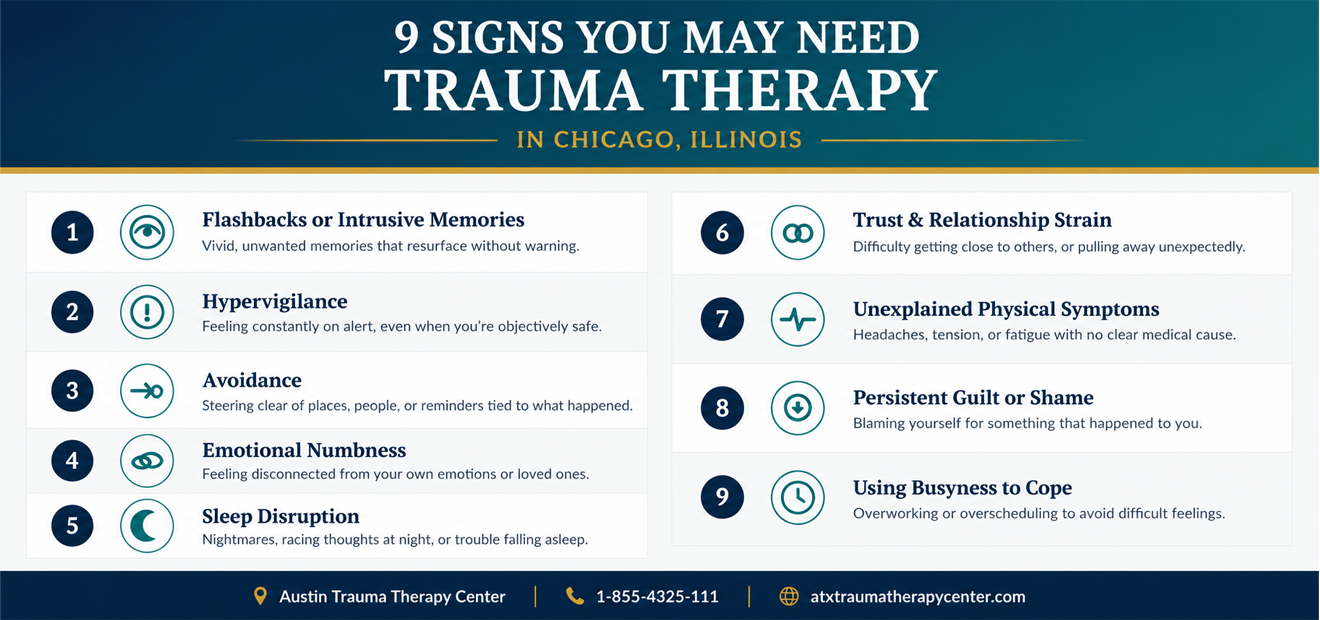
9 Signs You May Need Trauma Therapy in Chicago
Flashbacks or intrusive memories — vivid, unwanted memories that resurface during ordinary moments, sometimes triggered by a smell, sound, or place.
Hypervigilance — feeling constantly “on alert,” scanning rooms or streets for danger even when you’re objectively safe.
Avoidance — steering clear of certain neighborhoods, conversations, people, or even the CTA route tied to a difficult memory.
Emotional numbness — feeling disconnected from your own emotions, or from people you care about.
Sleep disruption — nightmares, trouble falling asleep, or waking up with a racing heart for no clear reason.
Trust and relationship strain — difficulty getting close to others, or swinging between over-attachment and pulling away.
Unexplained physical symptoms — headaches, stomach issues, muscle tension, or fatigue that doctors can’t fully explain.
Persistent guilt or shame — blaming yourself for something that happened to you, even when logically you know it wasn’t your fault.
Using busyness or substances to cope — overworking, overscheduling, or drinking to avoid sitting with difficult feelings.
If several of these sound familiar, it doesn’t mean something is wrong with you — it means your nervous system is still trying to protect you from something that already happened. Trauma therapy helps your brain and body update that information.
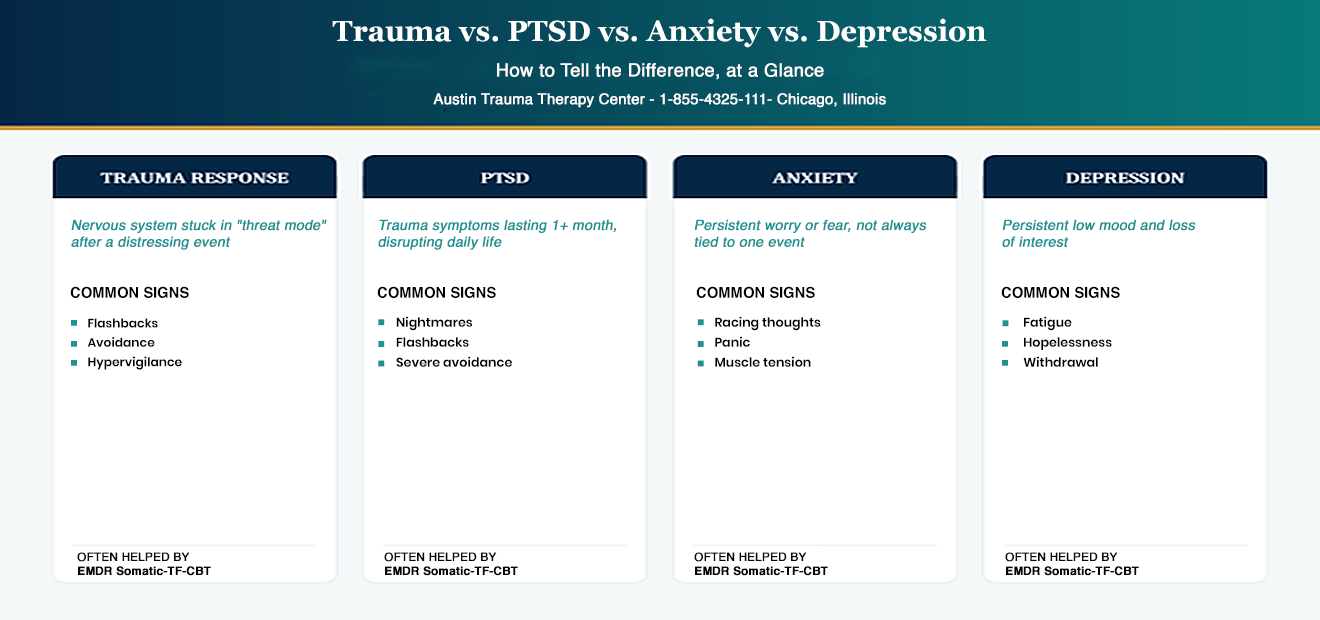
Trauma, PTSD, Anxiety, and Depression: How to Tell the Difference
These conditions often overlap, and a side-by-side comparison can help you see where your experience fits.
Condition
Core Feature
Common Signs
Often Helped By
Trauma response
Nervous system stuck in “threat mode” after a distressing event
Flashbacks, avoidance, hypervigilance
EMDR, somatic therapy, trauma-focused CBT
PTSD
Trauma symptoms lasting over a month and disrupting daily life
Nightmares, flashbacks, severe avoidance
EMDR, trauma-focused CBT
Anxiety
Persistent worry or fear, not always tied to a specific past event
Racing thoughts, panic, muscle tension
CBT, mindfulness-based therapy
Depression
Persistent low mood and loss of interest
Fatigue, hopelessness, withdrawal
CBT, behavioral activation
Someone with unresolved trauma may also meet criteria for PTSD, anxiety, or depression at the same time. That’s normal — and it’s exactly why a thorough assessment matters more than a single label. A trauma-informed therapist looks at the full picture rather than treating symptoms in isolation.
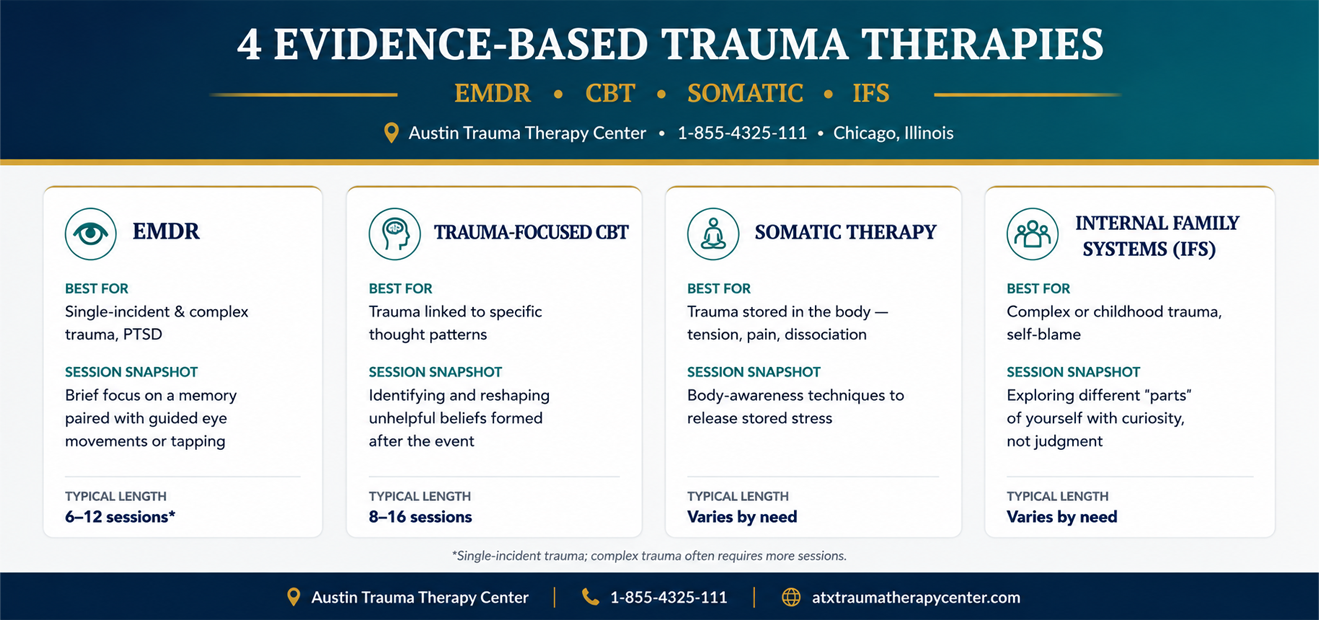
Evidence-Based Trauma Therapies That Work
Therapy
Best For
What a Session Involves
Typical Length
EMDR
Single-incident and complex trauma, PTSD
Brief focus on a memory paired with guided eye movements or tapping
6–12 sessions (single-incident); longer for complex trauma
Trauma-Focused CBT
Trauma linked to specific thought patterns
Identifying and reshaping unhelpful beliefs formed after the event
8–16 sessions
Somatic Therapy
Trauma stored in the body (tension, pain, dissociation)
Body-awareness techniques to release stored stress
Varies; often paired with EMDR or CBT
Internal Family Systems (IFS)
Complex or childhood trauma, self-blame
Exploring different “parts” of yourself with curiosity instead of judgment
Varies by individual need
EMDR is one of the most researched treatments for PTSD; the U.S. Department of Veterans Affairs lists it among the top recommended therapies for combat-related PTSD. Unlike traditional talk therapy, EMDR doesn’t require you to describe every detail of what happened. Many clients say this makes it feel more manageable, especially for memories that are hard to put into words. Your therapist will always assess whether EMDR — or another approach — fits your specific history and goals before beginning treatment.
Why Chicago Life Can Make Trauma Symptoms Harder to Manage
Trauma recovery doesn’t happen in a vacuum — your environment matters. Chicago’s fast pace, long commutes on the Blue, Red, or Brown lines, and demanding industries like finance, healthcare, and education can leave little room to process difficult experiences. Add in Midwest winters, when shorter days and less sunlight can worsen mood and energy, and it’s easy to see why trauma symptoms often intensify here rather than fade on their own.
City life can also create a paradox: you’re surrounded by millions of people, yet trauma often makes people feel more isolated than ever. Whether you live in Lincoln Park, Pilsen, Hyde Park, or the suburbs beyond the city limits, the pressure to keep up appearances — showing up to work, staying social, “pushing through” — can bury symptoms rather than resolve them.
A therapist who understands these local pressures can help you build coping strategies that fit your actual life, not a generic routine. In practice, that often looks like something simple: a 7:30am virtual session before the Loop commute starts, or a Saturday slot for someone whose job doesn’t allow weekday flexibility. Small logistics like that determine whether therapy is sustainable or one more thing that falls off the calendar by week three.
What Happens in Your First Trauma Therapy Session
Starting therapy can feel intimidating, especially if you’ve never talked about what happened. Your first session typically focuses on your history, current symptoms, and goals — not a deep dive into the traumatic event itself. Your therapist will ask questions to understand what you’ve experienced and how it’s affecting your daily life, then explain which treatment approach might help.
You won’t be asked to relive the trauma in detail right away. Trauma-informed care is built around trust and pacing; your therapist will move at a speed that feels safe for you, building coping tools before any deeper processing work begins. It’s also completely normal to feel nervous, unsure what to share, or emotional during this first conversation — some clients cry, some go quiet, some talk fast to get through it. All of that is fine. A good trauma therapist will meet you exactly where you are, without pressure or judgment.
In-Person or Virtual Trauma Therapy in Chicago — Which Is Right for You?
Both options are effective, and the right choice depends on your comfort and schedule. In-person therapy can feel more grounding for people who benefit from a dedicated, distraction-free space, or for approaches like somatic therapy that involve body awareness.
Virtual trauma therapy offers flexibility for busy professionals, parents, or anyone who wants to start sooner without adding a commute. EMDR, CBT, and talk therapy all translate well to secure video sessions, and research shows telehealth EMDR can be just as effective as in-person sessions for many clients.
Illinois residents can typically access either format, often with the same therapist, so you can adjust as your needs change — starting virtual during a busy season, for example, and shifting to in-person later.
How Austin Trauma Therapy Center Supports Chicago Clients
Austin Trauma Therapy Center (ATTC) provides trauma-informed care to clients throughout Illinois, including Chicago, through licensed therapists trained in EMDR, trauma-focused CBT, somatic therapy, and Internal Family Systems. Every clinician on our team completes ongoing training in trauma-informed practices, and treatment plans are built around your specific history rather than a one-size-fits-all program.
We know that reaching out is often the hardest step. That’s why our approach centers on flexibility: secure virtual sessions for Illinois residents, evening and weekend scheduling options, and a judgment-free intake process designed to help you feel supported from the first conversation. Whether you’re managing PTSD, anxiety, depression, or the lingering effects of childhood trauma, our team works collaboratively with you to set a pace and plan that fits your life.
Recovery looks different for everyone, and there’s no “right” timeline for healing. What matters most is working with a team that listens, explains your options clearly, and adapts care as you grow.
When to Reach Out
You don’t need to hit a breaking point before seeking support. If any of the signs above have been present for a few weeks or more, or if they’re affecting your work, relationships, or daily functioning, it’s a reasonable time to talk with a professional.
If you’re in Chicago or anywhere in Illinois and recognize yourself in this article, reaching out for an initial conversation costs nothing but a little vulnerability — and it could be the first step toward feeling steadier, calmer, and more like yourself again. Contact Austin Trauma Therapy Center to schedule a session, or explore our trauma therapy services in Chicago, IL to learn more about what treatment could look like for you.
FAQs
1. How do I know if I need trauma therapy versus regular counseling?
General counseling can help with everyday stress, but trauma therapy uses specialized approaches like EMDR to address the way traumatic memories are stored in the brain and body. If standard talk therapy hasn’t relieved symptoms like flashbacks or hypervigilance, trauma-focused treatment may be the missing piece.
2. Can trauma symptoms show up years after the event?
Yes. It’s common for trauma symptoms to surface months or even years later, often triggered by a new stressor, life transition, or reminder of the original event.
3. What’s the difference between PTSD and complex PTSD (C-PTSD)?
PTSD typically follows a single traumatic event, while complex PTSD develops after repeated or prolonged trauma, such as ongoing childhood neglect or long-term abuse. Complex PTSD often includes additional challenges with self-worth and relationships.
4. Is EMDR painful, or will I have to relive my trauma in detail?
EMDR does not require you to describe every detail of what happened. You’ll briefly focus on a memory while your therapist guides bilateral stimulation, and most clients find the process far less distressing than traditional exposure-based approaches.
5. How soon will I feel better after starting trauma therapy?
Many clients notice initial relief within a few sessions, though meaningful progress for single-incident trauma often takes 6–12 EMDR sessions. Complex or long-standing trauma typically requires more time.
6. Can I benefit from trauma therapy without one specific traumatic event?
Yes. Ongoing stress, neglect, or a difficult upbringing can create trauma responses even without one identifiable incident. Trauma therapy still applies and can be highly effective.
7. What if I’m not ready to talk about what happened?
That’s completely normal, and you’re never required to share more than feels safe. Trauma-informed therapists build trust and coping skills first, at your pace.
8. Does insurance cover trauma therapy in Chicago?
Many providers accept insurance or offer flexible payment options for trauma therapy. It’s worth asking your provider directly about your specific plan and any sliding-scale options.
9. Can trauma therapy help with the stress and burnout of city life?
Yes. Trauma therapy addresses the nervous system’s stress response, which often overlaps with burnout symptoms like exhaustion, irritability, and difficulty relaxing — common experiences for Chicago’s fast-paced professionals.
10. How do I choose the right trauma therapist in Chicago?
Look for a licensed clinician with specific training in trauma treatment (such as EMDR certification), and consider scheduling a consultation to see if their approach feels like a good fit for you.
Conclusion
Recognizing the signs of unresolved trauma is often the hardest part — after that, healing becomes a series of manageable steps rather than one overwhelming leap. Whether your experience involved a single event or years of accumulated stress, evidence-based trauma therapy in Chicago can help you feel calmer, safer, and more in control of your life again. If you’re ready to talk with a licensed, trauma-informed therapist, reach out to Austin Trauma Therapy Center today to schedule your first session.
Sometimes, your mind sends signals that something is not right. You may feel worried all the time, lose interest in things you once enjoyed, or struggle to stay focused on simple tasks. Knowing when to seek help can make a big difference.
A Therapist in Chicago can help you understand your symptoms and find the right support. Therapy or psychiatric care may be helpful when symptoms affect your daily life, relationships, work, sleep, or ability to manage everyday responsibilities and do not improve on their own.
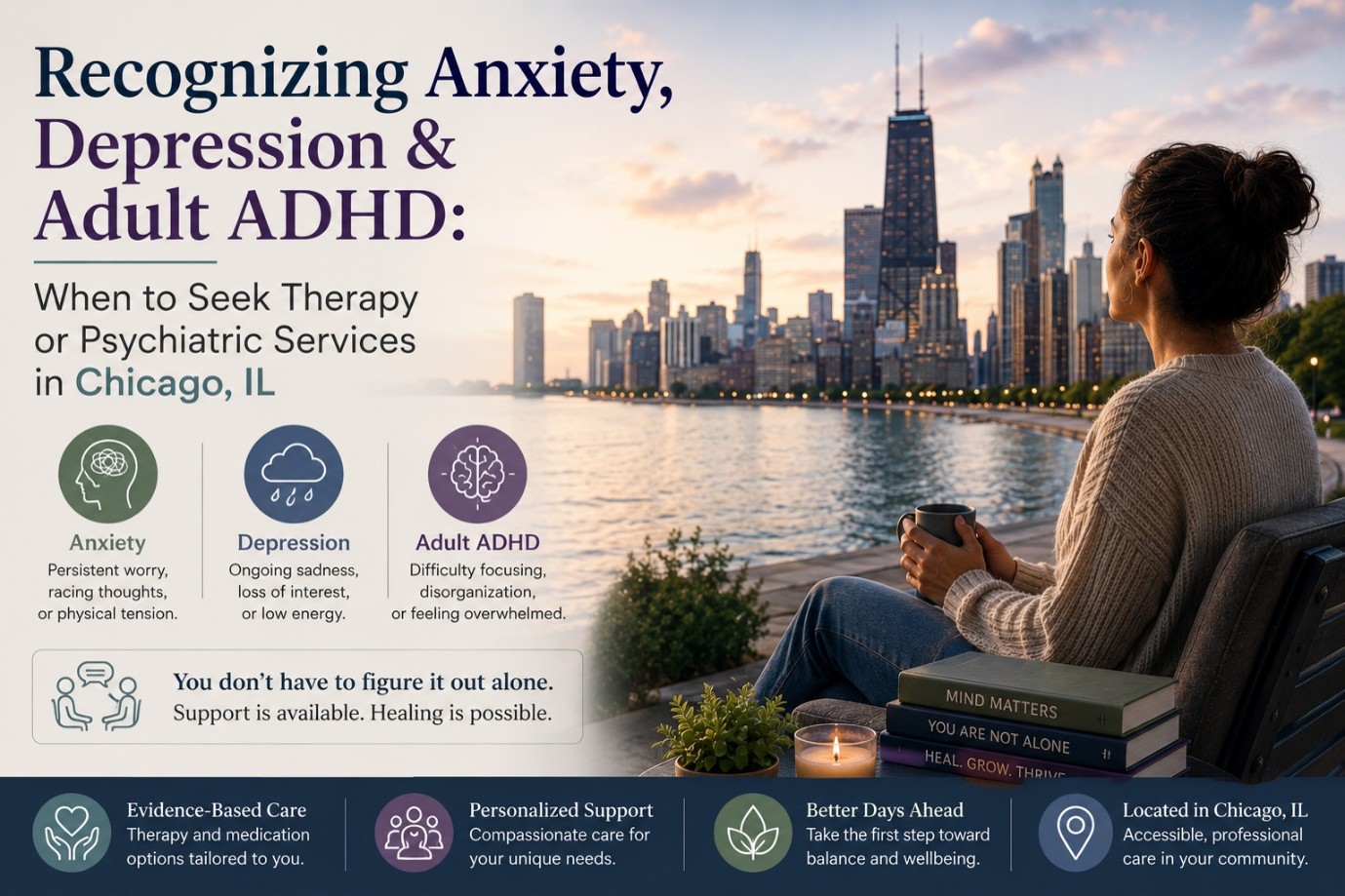
Understanding Anxiety: When Worry Becomes Too Much
Everyone feels worried from time to time. It is normal to feel nervous before an important event or when facing a difficult situation. Anxiety becomes a concern when worry starts to feel constant or difficult to control.
You may spend a lot of time thinking about what could go wrong. You might also feel restless, tense, or unable to relax. Some people notice physical signs, such as a fast heartbeat, upset stomach, sweating, or trouble sleeping.
If anxiety makes it hard to enjoy life or complete everyday tasks, talking with a mental health professional may help. Therapy can help you understand what triggers your anxiety and teach you healthy ways to manage stressful thoughts and feelings.
Recognizing the Signs of Depression
Depression is more than feeling sad after a difficult day. It can affect your mood, energy, thoughts, sleep, and interest in activities.
You may feel tired even after getting enough rest. Things that once made you happy may no longer feel enjoyable. You might also feel hopeless, isolated, guilty, or have trouble focusing.
Depression can look different for everyone. Some people may hide their feelings and continue working or caring for their families while struggling inside.
If these feelings continue or begin to affect your daily life, it may be time to seek professional support. A mental health professional can help you understand your symptoms and explore treatment options that match your needs.
Understanding Adult ADHD
ADHD is often linked to children, but adults can experience it too. Adult ADHD may affect attention, organization, time management, memory, and the ability to complete tasks.
You may start many projects but struggle to finish them. You might forget appointments, lose important items, or have trouble keeping track of deadlines. Some adults also experience restlessness or difficulty managing impulses.
These challenges can affect work, relationships, finances, and confidence. However, struggling with focus does not always mean you have ADHD. Stress, anxiety, depression, sleep problems, and other concerns can cause similar symptoms.
If attention problems have been present for a long time and affect different parts of your life, consider speaking with a qualified professional for an evaluation.
When Should You Seek Professional Help?
Knowing when to ask for help can be difficult. You may wonder if your concerns are serious enough or worry that you should handle them on your own.
You may want to consider professional support if you:
Feel that your symptoms are getting worse or lasting for a long time.
Struggle to manage work, school, relationships, or daily responsibilities.
Find that anxiety, sadness, or attention problems affect your quality of life.
Have tried to manage your symptoms alone but are not seeing improvement.
Feel overwhelmed and are unsure how to move forward.
You do not need to wait until your symptoms become severe. Seeking support early can help you understand what is happening and learn ways to cope.
Therapy or Psychiatric Services: Which Do You Need?
Therapy and psychiatric services can both play important roles in mental health care, but they serve different purposes.
A therapist can help you explore thoughts, emotions, behaviors, relationships, and past experiences. Therapy may include approaches such as Cognitive Behavioral Therapy, trauma-focused therapy, or other evidence-based methods.
A psychiatrist is a medical doctor who specializes in mental health. They can assess mental health conditions, provide medical treatment, and prescribe medication when appropriate.
Sometimes, people benefit from both therapy and psychiatric care. For example, someone with depression may use therapy to work on thought patterns while also receiving medical support for symptoms.
The best choice depends on your needs. A professional can help you understand which type of care may be appropriate.
How Group Therapy Can Support Your Mental Health
You do not always have to go through difficult experiences alone. Group Therapy in Chicago IL can provide a supportive setting where people with similar concerns can connect and learn together.
In a group setting, you may hear different perspectives and realize that others understand some of the challenges you face. Groups may focus on areas such as anxiety, trauma, relationships, coping skills, or emotional wellness.
Group therapy can also help you practice communication and build healthy connections. However, it is not the right fit for everyone. A therapist can help you decide whether group or individual therapy is more suitable for your needs.
Frequently Asked Questions
Is group therapy as effective as individual therapy?
Group therapy can be helpful for many people, especially when shared experiences and peer support are valuable. The best format depends on your needs, comfort, and treatment goals.
What happens during a group therapy session?
A trained therapist guides the group through discussions and activities related to shared concerns. Members can learn coping skills, share experiences, and support one another.
Getting Support for Trauma and Abuse
Past trauma and abuse can affect your mental health long after the experience has ended. You may struggle with fear, trust, anger, sadness, or feelings of being unsafe.
Chicago trauma abuse counseling can provide a safe space to explore these experiences without judgment. A trauma-informed therapist can help you understand how the past may affect your thoughts, emotions, and relationships today.
You do not have to share everything before you feel ready. Therapy should move at a pace that respects your comfort and sense of safety.
Frequently Asked Questions About Trauma Counseling
Can trauma cause anxiety or depression?
Yes. Difficult or traumatic experiences may contribute to anxiety, depression, and other emotional challenges. A professional can help explore these connections and create an appropriate treatment plan.
Do I have to talk about my trauma right away?
No. A trauma-informed therapist can first help you build trust and learn coping skills. You can discuss painful experiences when you feel safe and ready.
ADHD Coaching and Practical Support
For adults who have ADHD-related challenges, coaching can offer practical tools for everyday life. ADHD Coaching in Chicago IL may help with organization, time management, routines, planning, and reaching personal goals.
ADHD coaching is different from therapy or psychiatric care. It focuses more on practical skills and daily challenges. Depending on your needs, coaching may work alongside other forms of mental health support.
Frequently Asked Questions
Can ADHD coaching replace ADHD treatment?
ADHD coaching does not replace professional diagnosis or medical care. It can provide practical support and may complement therapy or other treatment recommended by a qualified professional.
Connect With Us Now!!
You do not have to figure everything out alone. Anxiety, depression, and adult ADHD can affect many parts of life, but the right support can make challenges easier to manage. If you are unsure whether you need therapy, psychiatric care, or practical coaching, a professional can help you explore your options.
At Austin Trauma Therapy Center, we are here to provide compassionate support that respects your needs and helps you take meaningful steps toward greater emotional health and well-being.
Healing is not about pretending difficult experiences never happened. It is about finding the right support to feel safe, calm, and in control again. When looking for mental health care, you may wonder whether trauma therapy or PTSD therapy is the better choice.
If you are also seeking Depression Treatment in Chicago IL, it is important to understand how different concerns can overlap. The right support depends on your symptoms, experiences, and goals. A trained therapist can help you choose the most helpful path toward healing and emotional well-being.
Understanding Trauma and PTSD
Trauma is a response to a deeply upsetting or frightening experience. It can happen after an accident, abuse, violence, neglect, loss, or another event that makes you feel unsafe.
Not everyone who experiences trauma develops PTSD. Some people recover with time and support, while others continue to have symptoms that affect daily life.
PTSD, or post-traumatic stress disorder, is a mental health condition that can develop after trauma. Symptoms may include upsetting memories, nightmares, flashbacks, avoiding reminders of the event, feeling constantly alert, or having strong emotional reactions.
Understanding this difference is important when choosing care. Trauma therapy can help people work through the effects of difficult experiences, while PTSD-focused treatment may be more specific to people who meet the symptoms of PTSD.
What Is Trauma Therapy?
Trauma therapy is a broad term for treatments that help people understand and recover from the effects of traumatic experiences. It can be useful even if you do not have a formal PTSD diagnosis.
A trauma-informed therapist may help you explore how past experiences affect your thoughts, emotions, behaviors, relationships, and sense of safety. The goal is not to force you to remember everything or talk about painful experiences before you are ready.
Instead, treatment focuses on building trust, learning coping skills, and helping you process difficult experiences at a safe pace.
What Is PTSD Therapy?
PTSD therapy focuses on symptoms related to post-traumatic stress disorder. It can help people understand their reactions and develop healthier ways to respond to memories and triggers.
Specialized PTSD therapy in Las Vegas NV is one example of care designed to support people dealing with trauma-related symptoms. However, treatment needs can vary based on your personal history and location. A qualified mental health professional can help determine whether your symptoms may be connected to PTSD and guide you toward appropriate care.
Trauma Therapy vs. PTSD Therapy: What Is the Difference?
The main difference is the focus of treatment. Trauma therapy can address the broad effects of traumatic experiences, while PTSD therapy often focuses on symptoms linked to post-traumatic stress disorder.
Trauma Therapy
PTSD Therapy
Focuses on the emotional effects of trauma.
Focuses on symptoms related to PTSD.
Can help people with or without a PTSD diagnosis.
Often used when someone has PTSD symptoms or a diagnosis.
May address anxiety, fear, trust, self-esteem, and emotional responses.
May focus on flashbacks, nightmares, avoidance, and feeling constantly on alert.
Can use different trauma-informed therapy methods.
May use evidence-based treatments designed to reduce PTSD symptoms.
Frequently Asked Questions About Trauma and PTSD Therapy
Can trauma therapy help if I do not have PTSD?
Yes. Trauma therapy can support people who experience the effects of difficult events without having a formal PTSD diagnosis. Treatment can focus on coping, emotional healing, and personal growth.
Is PTSD therapy only for people with severe trauma?
No. PTSD symptoms can develop after different types of traumatic experiences. A mental health professional can help determine whether your symptoms may benefit from specialized PTSD-focused treatment.
When Depression Is Part of the Picture
Trauma and PTSD are not the only concerns that can affect your mental health. Some people also experience depression after difficult or stressful experiences.
Depression may cause ongoing sadness, low energy, hopelessness, changes in sleep, or a loss of interest in activities. When depression and trauma occur together, it can be helpful to consider both when creating a treatment plan.
Depression Treatment in Chicago IL may help people understand their symptoms and learn strategies for managing difficult emotions. A therapist can explore how your experiences may connect to your current mood and help you identify steps toward feeling better.
Treatment may involve talking therapy, coping skills, behavior changes, or other appropriate support based on your needs.
When Attention and Focus Are Also a Concern
Mental health challenges can sometimes overlap in ways that are difficult to understand. If you struggle with attention, organization, time management, or completing everyday tasks, ADHD may also be part of the picture.
For adults who have ADHD-related challenges, Adult ADHD coaching services in Chicago IL may provide practical support for building routines, improving organization, managing time, and reaching personal goals.
ADHD coaching is different from trauma or PTSD therapy, but understanding all of your needs can help create a more complete picture of your mental health. If you are unsure what type of support you need, talking with a qualified professional can be a helpful first step.
Signs You May Benefit From Professional Support
You do not have to wait until your symptoms become overwhelming before seeking help. Professional support may be worth considering if you:
Feel unable to move past a painful or frightening experience.
Have upsetting memories, nightmares, or strong reactions to reminders.
Feel constantly worried, unsafe, disconnected, or emotionally numb.
Experience ongoing sadness or lose interest in activities you once enjoyed.
Struggle with attention, organization, or daily responsibilities.
Seeking help does not mean you are weak. It means you are taking your mental health seriously and giving yourself an opportunity to heal.
Frequently Asked Questions About Choosing Mental Health Support
How do I know which type of therapy is right for me?
A therapist can review your symptoms, experiences, and goals to help identify the most suitable approach. You do not need to choose before your first appointment.
Can I receive treatment for more than one concern?
Yes. A therapist can consider multiple concerns, such as trauma, PTSD, depression, or ADHD-related challenges, when creating a personalized treatment plan.
What to Expect When Starting Therapy
Your first therapy session is often a chance to share what brings you to treatment. You may talk about your concerns, personal history, symptoms, and goals.
You can also ask questions about the therapist’s experience and treatment methods. You should feel comfortable discussing your needs and expressing concerns about the process.
Trauma therapy should move at a pace that feels safe. You should never feel pressured to share more than you are ready to discuss.
Finding the right therapist may take time. A strong therapeutic relationship is built on trust, respect, communication, and a shared understanding of your goals.
Frequently Asked Questions About Starting Therapy
Do I have to talk about my trauma right away?
No. A trauma-informed therapist can first help you build trust and learn coping skills. You can decide when you feel ready to discuss difficult experiences in greater detail.
Take the Next Step Toward Better Mental Health
Choosing between trauma therapy and PTSD therapy can feel confusing, especially when you are unsure how your symptoms fit together. The right support starts with understanding your experiences and finding care that matches your needs.
Whether you are seeking Depression Treatment in Chicago IL or support for trauma-related concerns, professional guidance can help. At Austin Trauma Therapy Center, we are here to provide compassionate, personalized care and help you take meaningful steps toward greater emotional well-being and healing.
Healing from trauma can take time, but the right support can make the path easier. If you are looking for help with mental health in Las Vegas, Nevada, you may wonder which type of therapy is best for you.
EMDR, Internal Family Systems, and Trauma-Focused CBT are three helpful options. Each one works in a different way and may fit different needs. The best choice depends on your experiences, feelings, goals, and comfort. Trauma therapy can help you find the approach that fits you best.
Why Choosing the Right Trauma Therapy Matters?
Numerous aspects of your life may be impacted by trauma. It can change how you think, feel, sleep, behave, and connect with other people. Some people have unpleasant dreams or memories. Others may feel worried, angry, numb, or disconnected from the world around them.
You may also notice that certain places, words, or events bring back strong feelings. Even when you know you are safe, your body may react as if something bad is about to happen.
The right therapy can help you understand these reactions. It can also teach you healthy ways to handle difficult thoughts and feelings. For example, PTSD therapy in Las Vegas NV may help people manage trauma-related symptoms and learn healthy coping skills. However, one type of therapy may not work the same way for everyone.
Your past experiences, current symptoms, and personal goals are important when choosing treatment. A trained therapist can explain your options and help you choose a plan that feels safe, comfortable, and helpful for your healing journey.
EMDR: A Way to Work Through Painful Memories
It is a type of therapy that can help people work through painful memories and traumatic experiences.
During EMDR, you may think about a difficult memory while following a therapist’s guided eye movements or other gentle movements. This process may help your brain handle the memory in a new way.
EMDR may be helpful if you experience:
Flashbacks, nightmares, or upsetting memories.
Strong feelings when something reminds you of the past.
Fear or anxiety connected to a traumatic event.
A feeling that you cannot move forward from what happened.
EMDR does not make you forget your past. Instead, it may help make painful memories feel less powerful. You may still remember what happened, but the memory may no longer cause the same level of fear or distress.
Internal Family Systems: Learning About Your Inner Parts
Internal Family Systems, also called IFS, looks at the different parts of your personality and emotions. It suggests that we all have different parts inside us that may have developed because of our life experiences.
IFS helps you understand these parts instead of feeling ashamed or angry with yourself. With support from a therapist, you can learn why these parts developed and what they are trying to do for you.
This approach may be helpful if you:
Feel confused by strong or changing emotions.
Often struggle with shame or being hard on yourself.
Want to understand why you react in certain ways.
Choose a kind strategy that fosters self-kindness.
The goal is to better understand yourself and learn how to respond to difficult feelings with more patience and calm.
Trauma-Focused CBT: Changing Thoughts and Behaviors
Trauma-Focused Cognitive Behavioral Therapy, or TF-CBT, combines trauma care with CBT skills. It helps people understand how difficult experiences can affect their thoughts, feelings, and actions.
After trauma, you may start to believe things that are not helpful or true. You may think you are always in danger, that something bad will happen again, or that what happened was your fault.
TF-CBT can help you notice these thoughts and learn healthier ways to think about yourself and your experiences.
TF-CBT is often used with children and teenagers who have experienced trauma. Its ideas and techniques may also be useful in trauma treatment for adults.
How Do You Know Which Approach Is Right for You?
There is no single therapy that works best for everyone. The right choice depends on your needs, goals, symptoms, and what makes you feel comfortable.
If you want a structured way to work through painful memories, EMDR may be an option. If you want to understand your emotions and inner struggles, IFS may feel like a good fit. If you want to work on thoughts, feelings, and behaviors, Trauma-Focused CBT may be helpful.
Sometimes, a therapist may use ideas from more than one approach. Talking with a trained professional can help you understand your choices and decide what may work best for you.
Frequently Asked Questions About Choosing Trauma Therapy
Is EMDR better than Trauma-Focused CBT?
Neither therapy is always better. Both can help with trauma, but the best choice depends on your symptoms, personal history, goals, and which approach feels most comfortable for you.
Can I use IFS and EMDR together?
Sometimes, therapists may use more than one therapy approach. IFS can help you understand your emotions, while EMDR may help you work through specific painful memories.
Trauma Therapy and Other Mental Health Concerns
Trauma does not always happen by itself. Some people may also experience anxiety, depression, or PTSD after difficult life experiences.
If you often feel sad, hopeless, tired, or no longer enjoy things you once loved, Depression therapy in Las Vegas NV may help you understand these feelings and find ways to manage them.
If you have flashbacks, nightmares, avoid reminders of trauma, or always feel on alert, PTSD therapy may provide specialized support.
A trauma-informed therapist can look at your whole story instead of focusing on only one symptom. This can help you receive care that fits your needs and supports your long-term healing.
What to Consider Before Starting Therapy
Finding the right type of therapy is important, but finding the right therapist also matters. A good therapist should help you feel safe, respected, and comfortable sharing your thoughts.
Before starting therapy, think about:
Whether the therapist has experience helping people with similar concerns.
Whether the therapy approach matches your goals.
Whether you feel comfortable asking questions.
Whether the therapist explains the process in simple terms.
Whether you feel included when making treatment decisions.
You do not need to know everything before your first appointment. Your therapist can explain different options and help you make a choice that feels right for you.
Frequently Asked Questions About Starting Trauma Therapy
What should I expect during my first trauma therapy session?
Your first session usually includes talking about your concerns, history, symptoms, and goals. You can also ask questions and decide if you feel comfortable with your therapist.
How long does trauma therapy usually take?
There is no set timeline for everyone. Treatment may take weeks or longer, depending on your symptoms, experiences, goals, progress, and chosen therapy approach.
Can I choose a different therapy approach later?
Yes. Your needs may change as you heal. You can talk with your therapist about changing or combining approaches if another method may better support your progress.
Taking the First Step Toward Healing
Choosing between EMDR, IFS, and Trauma-Focused CBT may feel difficult, but you do not have to decide alone. A trained therapist can help you understand each option and find a plan that fits your needs.
If you are exploring mental health in Las Vegas, Nevada, the right support can help you feel safer and stronger. At Austin Trauma Therapy Center, we offer caring, personalized support to help you understand your experiences, build healthy coping skills, and take positive steps toward healing.
Sometimes people feel sad, scared, worried, or upset. When these feelings stay for a long time, talking to a therapist can help. Many people want help but worry about the cost. The good news is that there are many choices for different budgets.
If you are looking for support for mental health in Las Vegas Nevada, you can find help that fits your needs. Learning about therapy costs can help you take the first step toward feeling happier and stronger.
Average Cost of Therapy in Nevada
Therapy can cost different amounts. In Nevada, one therapy visit may cost between $75 and $300. Certain locations might charge more, while others might charge less.
Most therapy visits last about one hour. Some people use insurance, which can help pay part of the cost. People looking for depression therapy in Las Vegas NV can often find services that work with their budget and insurance plan.
Why Therapy Costs Vary?
Not all therapy costs the same. Here are some reasons why.
Therapist Experience
Some therapists have more training and have helped people for many years. Because of this, they may charge more.
Type of Therapy
Different problems may need different kinds of help. For example, trauma therapy in Las Vegas NV often uses special tools and skills to help people heal after hard experiences.
Location
Therapy prices may be different depending on where you live. Bigger cities often have more choices, but costs can also be higher.
Insurance Coverage
Insurance can help pay for therapy. This can make it easier for people and families to get the support they need.
Affordable Therapy Options in Nevada
Therapy does not always have to cost a lot. It can be made more reasonably priced.
Use Health Insurance
Many health insurance plans help pay for therapy.
You can ask about:
Mental health coverage
Therapists in your network
Copays
Number of covered visits
Sliding Scale Fees
Some therapists charge less money if a person has a lower income. This is called a sliding scale fee.
Community Mental Health Centers
Community centers often offer therapy at lower prices. They help many people get support when money is tight. Many people looking for PTSD therapy in Las Vegas NV find that insurance, payment plans, or lower-cost programs can make treatment easier to afford.
Online Therapy
Online therapy lets people talk to a therapist from home. It can sometimes cost less than going to an office.
Understanding Specialized Therapy Costs
Some people need special kinds of therapy. These services may cost more, but they can be very helpful.
Depression Therapy
Depression can make people feel very sad, tired, or unhappy. Therapy can help them feel better and enjoy life more.
Trauma happens when someone goes through something very scary, painful, or upsetting. Therapy can help people feel safe again. People seeking trauma therapy in Las Vegas NV often work with therapists who know special ways to help people heal from difficult experiences.
People looking for PTSD therapy can get help with feelings like fear, worry, bad memories, and stress.
Some common treatments include:
EMDR therapy
Trauma-focused CBT
Somatic therapy
Mindfulness practices
Is Therapy Worth the Cost?
Many people wonder if therapy is worth paying for. The answer is “yes” for a lot of families.
Therapy can help people:
Feel happier
Feel calmer
Handle stress better
Build stronger relationships
Learn healthy coping skills
Feel more confident
Getting help today can make life better tomorrow.
As they learn more about mental health in Las Vegas Nevada, many people find that therapy is a helpful investment in their health and happiness.
How to Find the Right Therapist Within Your Budget
Finding the right therapist does not have to be hard.
Here are a few simple ideas:
Check your insurance.
Ask about lower-cost fees.
Look at online therapy.
Compare different therapists.
Schedule a consultation.
Taking a little time to look at your choices can help you find the right support.
Start Your Healing Journey Today
Everyone deserves help when they are feeling sad, scared, stressed, or overwhelmed. If you are looking for support for mental health in Las Vegas Nevada, there are affordable therapy options available. Help is available for depression, trauma, PTSD, and many other challenges.
At Austin Trauma Therapy Center, we are here to support you with caring and effective therapy. Contact us today to learn how we can help you take the next step toward healing, hope, and a happier life.
People Also Ask
How much does therapy cost in Nevada?
The cost of therapy in Nevada is different for everyone. Most therapy sessions cost between $75 and $300. The price depends on the therapist’s experience, location, and type of treatment. Some clinics also offer lower-cost options to help more people get support.
Does insurance cover therapy?
Yes, many health insurance plans help pay for therapy and other mental health services. Plans can differ in what they cover. It is a good idea to contact your insurance provider to learn about covered services, copays, deductibles, and approved therapists.
Are there affordable therapy options in Las Vegas?
Yes, there are many affordable therapy options in Las Vegas. People can use insurance, community mental health programs, online therapy services, and sliding scale fees. These options help make professional support more accessible for individuals and families with different budgets.
Is trauma therapy more expensive than regular counseling?
Sometimes trauma therapy can cost more than general counseling because it often requires specialized training and treatment methods. Therapists may use approaches such as EMDR or trauma-focused therapy. However, insurance coverage and payment plans can help reduce overall treatment costs.
Can insurance cover PTSD treatment?
Yes, many insurance providers cover PTSD treatment when it is offered by a licensed mental health professional. Coverage may include therapy sessions, evaluations, and other mental health services. Checking your specific insurance plan can help you understand your available benefits.
Starting therapy can feel like a big step, especially if you do not know what to expect. If you are looking for trauma therapy in Chicago, IL, learning about therapy costs before your first visit can help you feel more comfortable.
Every person’s journey is different, and so is the cost of care. Knowing the basics will help you plan ahead and choose the support that fits your needs, goals, and budget.
What Shapes the Price of Therapy?
The cost of therapy is not the same for everyone. Different things can affect how much you may pay for each session.
Some of these include:
The therapist’s training and experience
The type of therapy you need
Individual or Group Therapy in Chicago IL
In-person or online sessions
Insurance coverage
Length of each appointment
Finding the best deal is not the only objective. It is to find care that helps you feel safe, heard, and supported.
What Is the General Cost of Therapy in Chicago?
Most therapy sessions in Chicago cost between $100 and $250 for one-on-one appointments. If you are looking for PTSD treatment in Chicago, the cost may be closer to the higher end because trauma care often uses special treatment methods.
Group Therapy in Chicago IL is usually more affordable. Group sessions often cost between $40 and $90 per visit. Some therapy practices also accept insurance, offer payment plans, or provide sliding-scale fees to make therapy easier to afford.
Small Things That Can Change the Cost
Many people wonder why one therapist charges more than another. Here are a few reasons.
Special Training
A skilled trauma therapist in Chicago may have extra training in treatments like EMDR or trauma-focused therapy. This special knowledge can affect the session fee.
Type of Therapy
Individual therapy gives you one-on-one support, so it often costs more. Group therapy is shared with others and usually costs less.
Experience
Therapists who have worked with trauma for many years may charge more because they have helped many people recover.
Insurance
If your insurance covers mental health services, you may pay much less out of pocket.
Is Therapy Worth the Money?
Therapy is an investment in yourself. It can help you feel better, think more clearly, and enjoy life again.
Many people choose therapy because it helps them:
Feel calmer during stressful times
Learn healthy ways to handle emotions
Heal from painful experiences
Build stronger relationships
Feel more confident
Improve daily life
Healing takes time, but the positive changes can last for many years.
Finding the Right Therapist Is Important
When searching for therapists in Chicago, try not to choose based only on price. A therapist who understands trauma can make a big difference in your healing.
Ask questions like:
Do they work with trauma?
Do they treat PTSD?
What therapy methods do they use?
Do they offer online sessions?
Do they accept insurance?
The right therapist should help you feel comfortable and respected from your very first visit.
Understanding the Cost of PTSD Treatment
Many people need special care after difficult or painful experiences. PTSD treatment in Chicago often includes proven therapy methods that help people feel safe again.
Treatment may include:
EMDR therapy
Trauma-focused CBT
Cognitive Processing Therapy
Mindfulness
Body-based therapy
Some people need only a few months of therapy. Others may benefit from longer care. Every healing journey is different, and there is no perfect timeline.
Is Group Therapy the Right Choice?
Group Therapy in Chicago IL can be a great option for many people. It gives you the chance to meet others who understand what you are going through.
Group therapy offers:
Lower session costs
Support from people with similar experiences
A safe place to share feelings
New coping skills
Encouragement from others
For additional assistance, many patients mix individual sessions with group therapy.
Plan Before Your First Appointment
Before your first therapy visit, it helps to ask a few simple questions.
You may want to know:
How much does each session cost?
Do you accept my insurance?
Are payment plans available?
What happens if I cancel?
How long is each appointment?
What should I expect during my first visit?
Knowing these answers can help you feel more relaxed before you begin therapy.
Looking Beyond the Price
The cost of therapy is only one part of the decision. The real value comes from feeling happier, healthier, and more confident every day. If you are looking for trauma therapy in Chicago, IL, choosing the right care can help you build healthy coping skills, improve relationships, and enjoy a better quality of life.
Investing in the right support today can create lasting positive changes for your future.
Take the First Step Toward Feeling Better
Choosing therapy is an important step toward healing and personal growth. At Austin Trauma Therapy Center, we believe everyone deserves kind, compassionate, and expert care.
We work closely with each person to understand their story and create a treatment plan that fits their needs. Whether you are beginning therapy for the first time or returning for continued support, we are here to help you move forward with confidence, hope, and lasting healing.
Frequently Asked Questions
How much does trauma therapy usually cost in Chicago?
Most individual therapy sessions cost between $100 and $250, depending on the therapist and the services offered.
Does insurance help pay for PTSD treatment?
Many insurance plans cover PTSD treatment in Chicago, but every plan is different. Asking your insurance company is always a smart idea.
Is Group Therapy less expensive?
Yes. Group Therapy in Chicago IL usually costs between $40 and $90 per session, making it a budget-friendly choice.
How do I choose a trauma therapist?
Look for a licensed trauma therapist in Chicago who has experience treating trauma and uses proven therapy methods.
How many therapy sessions will I need?
Everyone is different. Some people feel better after a few months, while others choose longer therapy based on their goals.